INU Institute of Environmental Convergence Technology Signs Multilateral MOU with Universities from Mongolia, Pakistan, Tajikistan, and Uzbekistan
- NO
- 432777
- Date
- 2026-11-05
- modification day
- 2026-11-05
- Writer
- 홍보과 (032-835-9490)
- Count
- 204
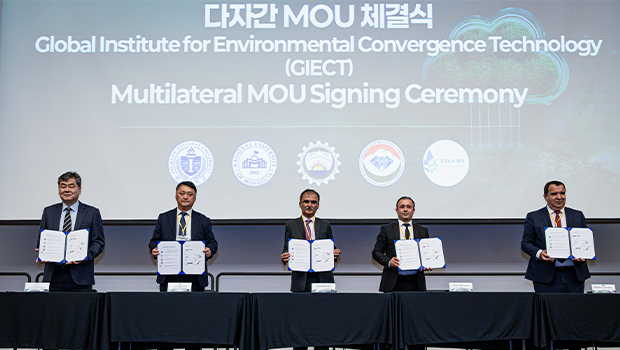
Multilateral Memorandum of Understanding (MOU) Signing Ceremony
● Universities from Four Countries Designated as GIECT International Partner Institutions… Accelerating Joint Research and Academic Exchanges
● Five-Year Cooperation in Environmental Convergence Technology… Expanding Country-Specific Cooperation Hubs into an International University Network
The Institute of Environmental Convergence Technology (GIECT) at Incheon National University (INU), led by President Injae Lee, announced that it signed a multilateral memorandum of understanding (MOU) with universities from Mongolia, Pakistan, Tajikistan, and Uzbekistan during the 2026 Incheon International Environmental Technology Confex, held at Songdo Convensia in Incheon. GIECT is headed by Director Lee Hee-kwan, a professor in INU's School of Urban and Environmental Engineering.
The agreement aims to establish a multilateral cooperation framework for joint academic and research activities in environmental convergence technology, with a particular focus on sustainable development, climate adaptation, and ecological resilience.
The agreement brings together GIECT and four universities from four countries: the National University of Mongolia, NED University of Engineering and Technology in Pakistan, the Mining and Metallurgical Institute of Tajikistan, and Tashkent Institute of Irrigation and Agricultural Mechanization Engineers National Research University in Uzbekistan.
Under the agreement, the four universities will be designated as GIECT International Partner Institutions and participate in GIECT's international partnership activities, including joint research project proposals, workshops, and annual partner meetings.
Areas of cooperation include joint research on environmental and climate challenges; exchanges of faculty members, researchers, and postdoctoral researchers; short-term training, internships, and joint supervision for graduate students; co-hosting international academic conferences and workshops; exchanging academic resources and datasets; and jointly securing external research funding.
Individual projects may be implemented bilaterally between INU and one partner institution or multilaterally with two or more participating institutions. Separate project-specific agreements will define the scope of activities, financial arrangements, intellectual property rights, and other relevant matters.
The agreement is expected to establish a foundation for disseminating research outcomes validated in one country to other countries in the region through multilateral cooperation. It is also anticipated to improve opportunities for securing international joint research funding, cultivate local expertise through exchanges of graduate students and early-career researchers, and facilitate the development of projects linked to official development assistance (ODA) and international organizations.
President Injae Lee of Incheon National University stated, “The key to addressing the interconnected crises of climate change and environmental pollution lies in technological innovation and cooperation that transcends national borders.” He added, “Technology is not an end in itself but a means to achieve sustainable living. We will fulfill our role as an innovation platform connecting technology and people, local communities and the world, ensuring that today's partnership leads to tomorrow's joint research and global commercialization.”
Lee Hee-kwan, Director of GIECT, stated, “This agreement goes beyond a declaration of cooperation between institutions. It aims to establish a practical framework that enables researchers and students to engage in meaningful exchanges.” He added, “Together with universities from the four countries, we will progressively advance joint research and human resource development in environmental and climate-related fields, positioning GIECT as a hub for environmental convergence technology cooperation in Asia.”
The agreement will remain valid for five years from the date of its final signature. GIECT and the four partner institutions will each designate a contact person to monitor progress and identify new opportunities for cooperation.
Building on this agreement, GIECT plans to develop concrete joint research projects aligned with the technological needs of each country and regularly review the outcomes of its partnerships through international partner meetings and joint workshops.
- Attachment
- There are no attachments.